

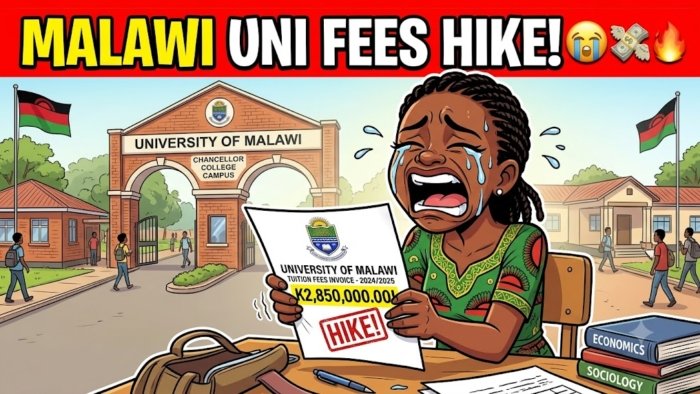
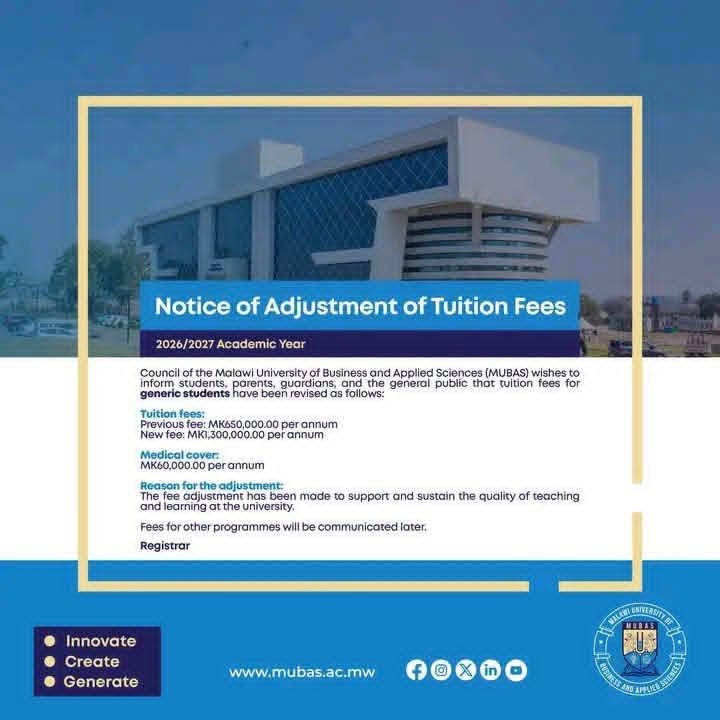
In recent weeks, Malawi has witnessed significant increases in tuition fees at public universities. While universities have legitimate reasons for seeking more revenue, rising operational costs, inflation, infrastructure maintenance, and improving the quality of education, the timing and scale of these increases raise a fundamental question:
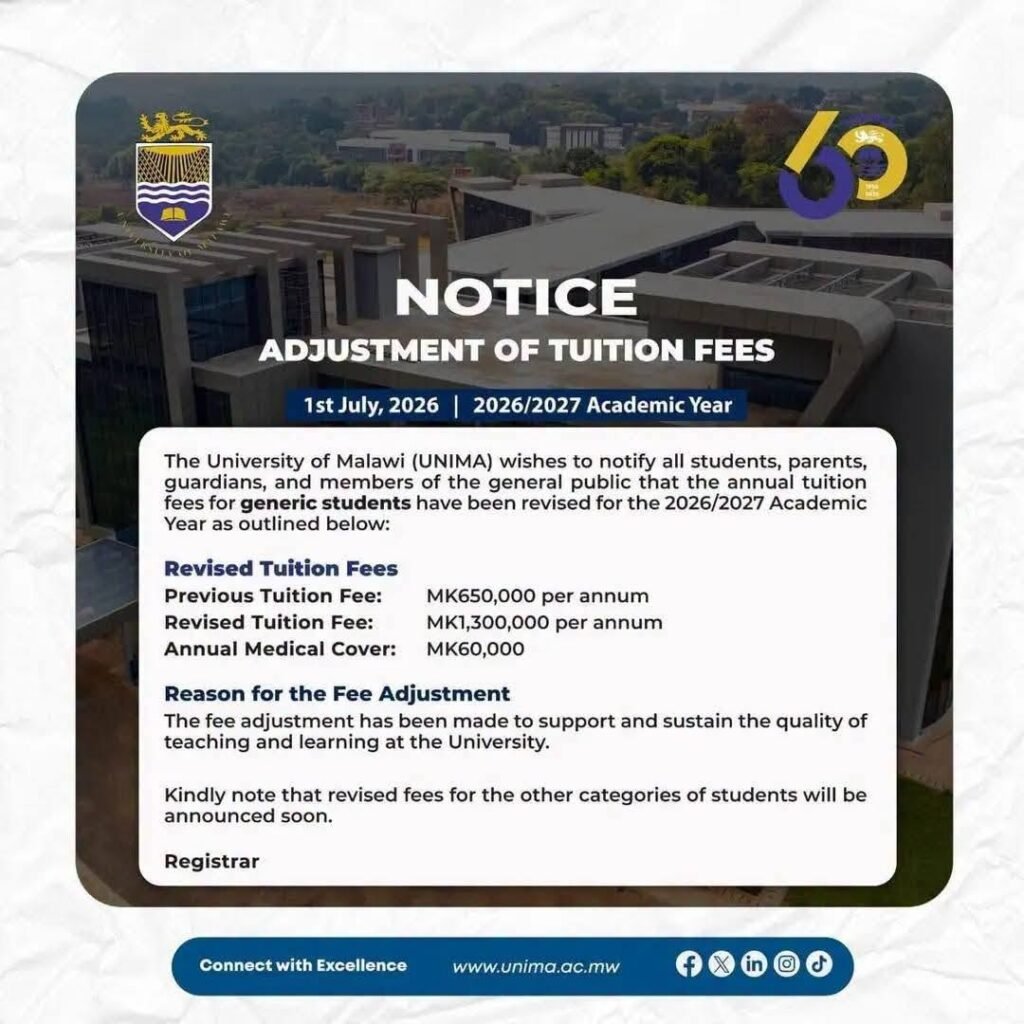
Can a country with Malawi’s economic realities afford to make higher education less affordable?
The debate should not be whether universities need more funding. They undoubtedly do. The real question is whether fee increases are being designed with the financial capacity of ordinary Malawians in mind.
Education Is Not Like Any Other Commodity
Education occupies a unique place in society. Unlike luxury goods or commercial services, education is an investment in a nation’s human capital. Every doctor, engineer, teacher, entrepreneur, scientist, journalist, and public servant begins in a classroom.
When access to education becomes increasingly dependent on one’s financial status, society risks wasting its greatest resource: talent.
The brightest student from a rural village should not be denied a university education simply because their family cannot absorb a sudden and substantial increase in tuition fees.
Public Universities Set the Tone
One reality of Malawi’s education sector is that public institutions often influence the pricing decisions of private institutions.
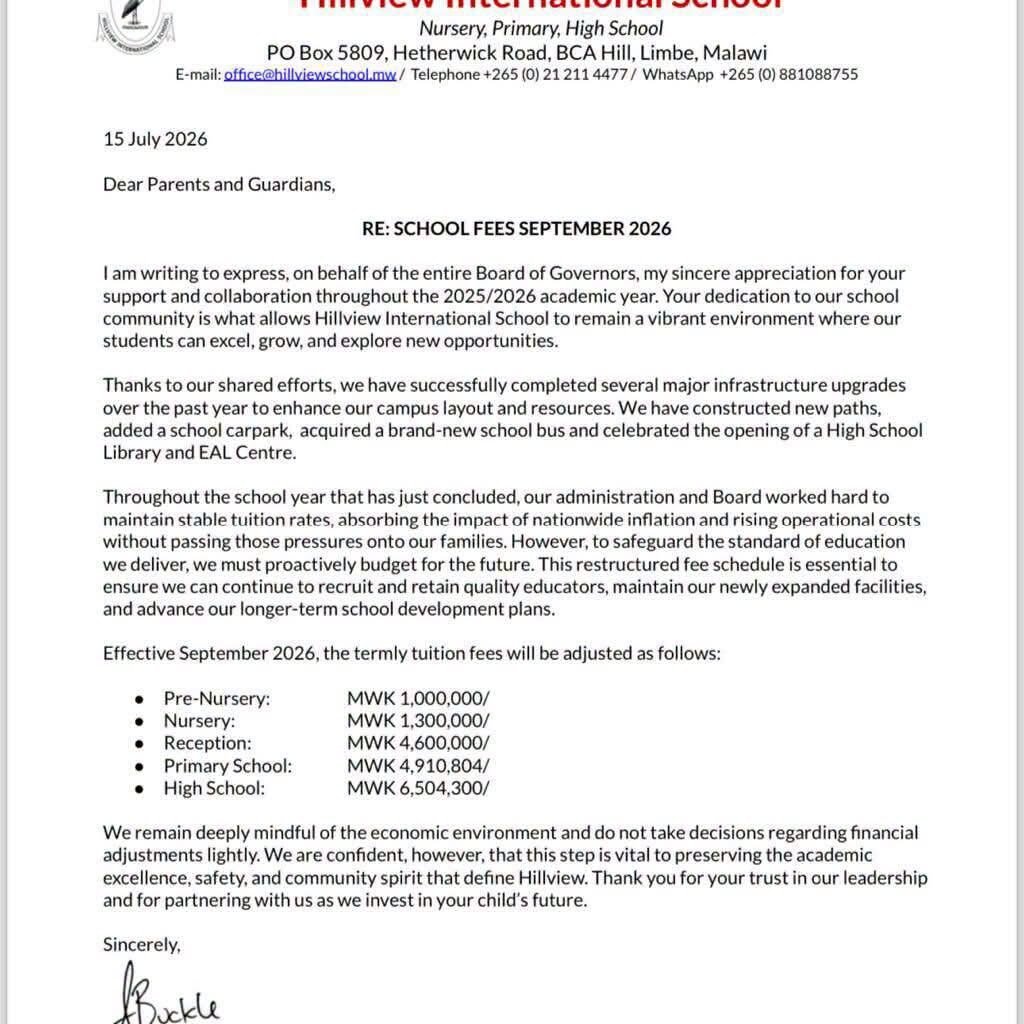
When public universities significantly increase tuition, private universities and even secondary schools are likely to adjust their own fees upward. They often justify these increases by pointing to rising costs across the education sector and by benchmarking against public institutions.
The result is a chain reaction.
What begins as a decision affecting public universities eventually impacts families whose children attend private universities, private secondary schools, and even smaller independent schools.
Education becomes more expensive across the board.
Should Fee Increases Reflect People’s Economic Reality?
Any increase in the cost of essential services should be viewed alongside people’s ability to pay.
Malawi remains one of the world’s lower-income countries, with many households already facing high living costs, unemployment, and stagnant incomes. For many families, paying school fees already requires enormous sacrifice.
If tuition fees rise substantially while household incomes remain largely unchanged, affordability inevitably declines.
The principle is straightforward:
The cost of education should not grow much faster than people’s capacity to afford it.
Otherwise, higher education gradually becomes accessible only to families with greater financial resources.
A Question of National Priorities
Governments have difficult fiscal choices to make, and universities cannot operate without adequate funding.
However, there is an important distinction between funding education and shifting a greater share of the cost onto students and their families.
Countries seeking long-term economic growth generally aim to expand access to education rather than restrict it.
Every student who is unable to attend university because of cost represents lost potential not only for that individual but also for the nation.
Malawi cannot build a knowledge-based economy while simultaneously making higher education increasingly unaffordable.
If Costs Rise, Should Incomes Rise Too?
There is another important question that deserves public discussion.
If the cost of education rises dramatically, should workers’ incomes also increase to preserve affordability?
While a 50% increase in the minimum wage is one proposal that some may advocate, wage policy depends on many economic factors, including productivity, inflation, employment, and the capacity of employers to absorb higher labor costs. It is therefore not a simple one-to-one solution.
Nevertheless, the underlying concern remains valid: when the prices of essential services rise much faster than incomes, families experience greater financial pressure.
Without corresponding improvements in household purchasing power, many students may defer, interrupt, or abandon their education.
Are We Solving or Deepening Malawi’s Education Crisis?
Malawi already faces significant educational challenges:
- Limited access to higher education.
- High dropout rates at different levels of education.
- Financial barriers affecting many households.
- Skills shortages in key sectors.
If higher education becomes even less affordable, these challenges could become more severe.
The long-term consequences may include fewer university graduates, greater inequality in educational opportunities, and slower national development.
Education Should Be an Investment, Not Merely a Revenue Stream
Universities require sustainable financing, and no serious observer disputes that reality.
However, public universities have a responsibility that extends beyond balancing budgets. They are institutions established to expand opportunity and develop the country’s human capital.
Education should never be viewed solely through the lens of revenue generation.
It is an investment whose returns are measured in stronger institutions, economic growth, innovation, better healthcare, better governance, and improved quality of life.
The Way Forward
Rather than relying primarily on substantial fee increases, Malawi should pursue a broader conversation about financing higher education. Possible approaches include expanding scholarships and student loan programs, strengthening public investment in universities, encouraging partnerships with the private sector and development partners, improving institutional efficiency, and ensuring that any fee adjustments are introduced gradually and transparently.
Most importantly, affordability should remain central to every policy decision.
Final Thoughts
A nation that makes education increasingly inaccessible risks limiting its own future.
Universities deserve adequate resources, lecturers deserve fair compensation, and students deserve quality education. These goals are not mutually exclusive.
But every decision on tuition fees should begin with one simple question:
Can the average Malawian family realistically afford this?
If the answer is increasingly “no,” then the discussion should not end with higher fees. It should continue with a broader national conversation about how Malawi can finance quality education while keeping it within reach of those whose futures depend on it.
Education should not become a privilege reserved for those who can afford it. It should remain one of the most powerful pathways for reducing poverty, expanding opportunity, and building a stronger Malawi.